Dock and Seawall Cleaning in Florida
The Chemical and Biological Reality of Florida Marine Structures
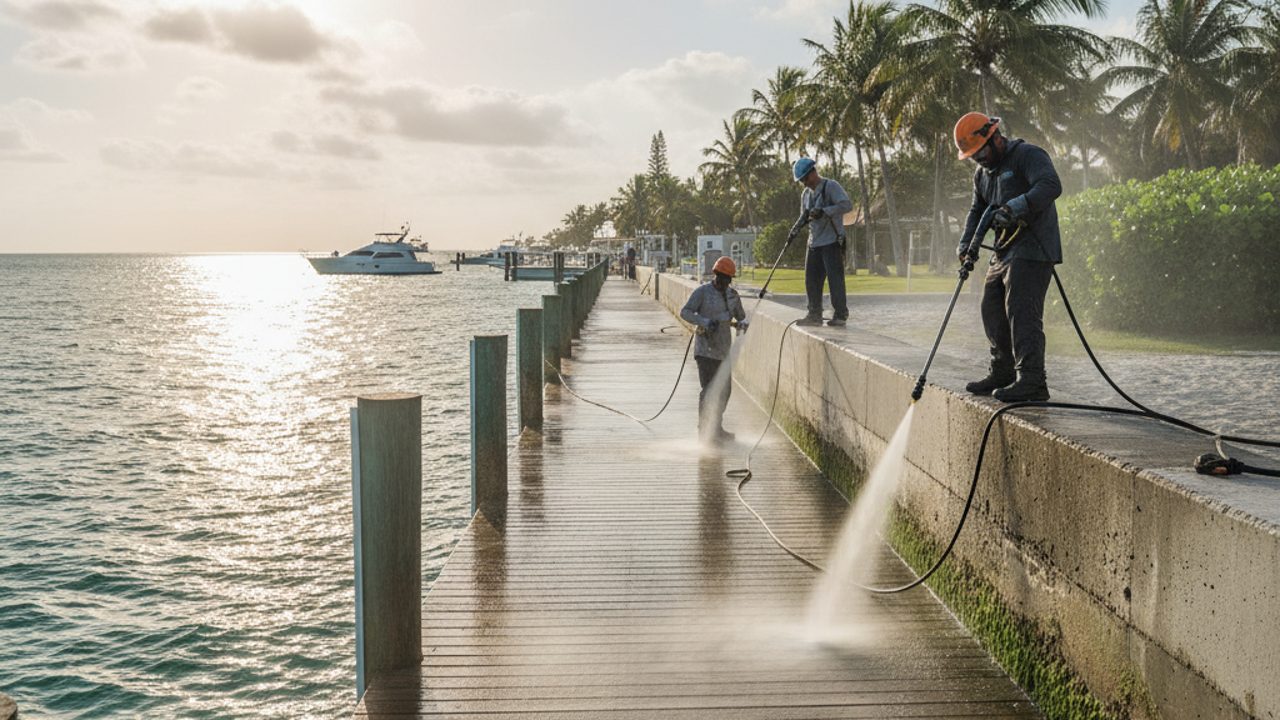
In Florida’s subtropical environment, docks and seawalls are under constant biological and chemical siege. The combination of high-salinity Atlantic or Gulf water and constant UV exposure creates a breeding ground for calcium-carbonate-secreting organisms, primarily barnacles and oysters, and aggressive algae species. For commercial marinas and waterfront residential properties, maintaining these structures is not merely an aesthetic choice; it is a structural necessity.
Salt crystallization within the pores of concrete seawalls—a process known as salt weathering—can lead to internal pressure that causes spalling and rebar corrosion. Meanwhile, uncontrolled marine growth adds significant dead weight to floating docks and undermines the structural integrity of pilings. Power Washing And More utilizes a technical approach that balances high-efficiency removal of biological growth with strict adherence to Florida’s environmental regulations regarding runoff and water quality.
Mechanical vs. Chemical Removal: The Technical Approach
Effective dock and seawall maintenance requires a tiered pressure strategy. While standard residential pressure washers often max out at 2,500 PSI, professional-grade equipment allows for variable pressure settings ranging from 3,000 to 4,500 PSI, which is necessary for mechanical barnacle removal.
Barnacle and Calcification Removal
Barnacles adhere to surfaces using a fast-curing proteinaceous cement that is remarkably resistant to shear force. To remove these without damaging the underlying substrate—especially on older concrete seawalls or wood pilings—our technicians utilize a zero-degree rotating turbo nozzle. This creates a high-frequency circular water pattern that shears the calcium carbonate shell from the surface.
Soft Washing for Marine Algae
For the upper portions of docks and seawalls where green and black algae thrive, high pressure can be counterproductive, particularly on pressure-treated lumber or composite decking like Trex. In these instances, we employ a 'Soft Wash' system. This involves applying a specialized solution, typically a 1% to 3% concentration of sodium hypochlorite mixed with biodegradable, pH-balanced surfactants. This mixture neutralizes organic spores at the root level without the surface-stripping risks of high PSI.
Environmental Stewardship and Mitigation
Cleaning a structure that sits directly over a waterway requires specialized chemical management. As a Florida-based company, Power Washing And More prioritizes the protection of the local ecosystem, including seagrass beds and manatee habitats.
We utilize professional-grade surfactants that are specifically labeled for marine use. These surfactants are designed to break down rapidly and do not contain phosphates which can trigger localized nitrogen spikes in the water column. During the cleaning process, we monitor the 'overspray' and employ neutralizing agents where necessary to ensure that the pH of the surrounding water remains within the standard 7.8 to 8.4 range typical of Florida’s brackish and salt waters.
Comparison of Cleaning Requirements by Material
| Material | Primary Threat | Cleaning Method | Recommended Frequency |
|---|---|---|---|
| Concrete Seawalls | Barnacles, Salt Spalling | High-Pressure Turbo Nozzle | Every 12-24 Months |
| Pressure-Treated Wood | Algae, Rot, Wood Borers | Soft Wash (Low PSI) | Every 6-12 Months |
| Composite (Trex/Azek) | Mold, Surface Staining | Medium PSI + Surfactant | Every 12 Months |
| Vinyl/PVC Sheet Piling | UV Degradation, Algae | Low Pressure / Soft Wash | Every 18-24 Months |
Protecting the Rebar: The Seawall Integrity Factor
One of the most critical aspects of seawall cleaning is the inspection of the 'cap' and the 'face.' Florida seawalls are typically reinforced with steel rebar. If the concrete becomes too porous due to salt saturation, the rebar begins to oxidize (rust). As rust expands, it forces the concrete to crack, a process known as 'spalling.'
By regularly removing the salt-laden biofilm and biological growth, we allow the concrete to 'breathe' and reduce the rate of chloride ion penetration. For commercial clients, maintaining a clean seawall face is often a requirement for insurance compliance and long-term asset management, preventing the need for five-figure structural repairs down the line.
Specialized Equipment for Waterfront Logistics
Logistics are the primary challenge for South Florida dock cleaning. Many residential docks have limited access or lack high-volume water hookups. Our mobile units are equipped with high-capacity water tanks and long-range hose reels (up to 300 feet) to ensure we can reach the furthest T-docks and pilings without needing to move heavy machinery onto delicate landscaping or narrow seawall caps.
We also utilize hot water pressure washing systems where applicable. Heating the water to 180°F—200°F allows for the emulsification of oils and grease (often found near boat lifts and fueling stations) without relying solely on aggressive chemical solvents.
FAQ: Dock and Seawall Maintenance
Will the cleaning process harm the fish or manatees under my dock?
We strictly adhere to BMPs (Best Management Practices) for marine cleaning. By using highly diluted sodium hypochlorite solutions and specialized marine-grade surfactants that break down almost instantly upon contact with large bodies of water, we minimize the impact on local fauna. We also ensure that no solid debris, such as large clusters of barnacles, are left to accumulate in sensitive areas.
How often should a South Florida seawall be professionally cleaned?
For optimal structural health, seawalls should be cleaned every 18 to 24 months. Docks, especially those made of wood or composite, typically require annual cleaning to prevent the surface from becoming a slip hazard due to algae growth (biofilm).
Can you remove the 'musty' smell coming from the seawall?
The odor associated with seawalls is usually caused by decaying organic matter (algae and trapped anaerobic bacteria) and stagnant water in the pores of the concrete. Our soft wash treatment kills these microorganisms at the source, effectively neutralizing the odor rather than just masking it.
Is high pressure safe for my older wooden dock pilings?
High pressure (above 3,000 PSI) can 'fur' or splinter older wood. We assess the integrity of the timber first. If the wood is compromised, we shift to a chemical-heavy, pressure-light approach to preserve the wood fibers while still removing the biological growth.