End of Rainy Season Mold and Algae Cleanup Guide
The Post-Rainy Season Biofilm Crisis in South Florida
South Florida’s rainy season, typically spanning from May through October, delivers an average of 40 to 60 inches of precipitation. For commercial and residential property owners, this sustained humidity and heat create a laboratory-grade environment for Gloeocapsa magma and various chlorophyta (green algae) strains. As the atmosphere dries out in November, the moisture trapped within porous substrates like barrel tiles, lime rock, and poured concrete provides a breeding ground for thick biofilms.
Leaving these organic contaminants untreated throughout the winter is a tactical error. When the rain stops, the mold and algae do not simply disappear; they enter a dormant state, hardening into the surface and causing microscopic structural pitting. Effective cleanup requires more than a standard garden hose; it demands a calibrated chemical approach to neutralize spores at the root.
Roof Restoration: Soft Washing vs. High-Pressure Risks
The most visible victim of the rainy season is the roof. In South Florida, concrete and clay tiles are standard, both of which are highly porous. When algae (the black streaks often mistaken for dirt) accumulate, they increase the roof's thermal mass, absorbing UV rays and spiking internal cooling costs.
At Power Washing And More, we strictly adhere to the Asphalt Roofing Manufacturers Association (ARMA) guidelines, which prohibit high-pressure cleaning. High-PSI streams can erode the protective finish of tiles and shatter the adhesive bonds of shingles. Instead, we utilize a Soft Wash system. This involves a specialized delivery pump that applies a sodium hypochlorite (SH) solution, typically at a 3% to 4% concentration for heavy growth, blended with high-viscosity surfactants. The surfactant allows the solution to cling to the pitch of the roof, dwelling long enough to chemically break down the cell walls of the mold without mechanical force.
Vertical Surfaces: Managing Runoff on Stucco and EIFS
South Florida architecture relies heavily on stucco and Exterior Insulation and Finish Systems (EIFS). These surfaces are notorious for holding moisture in their texture. By the end of October, the north-facing walls of most commercial buildings exhibit significant green staining.
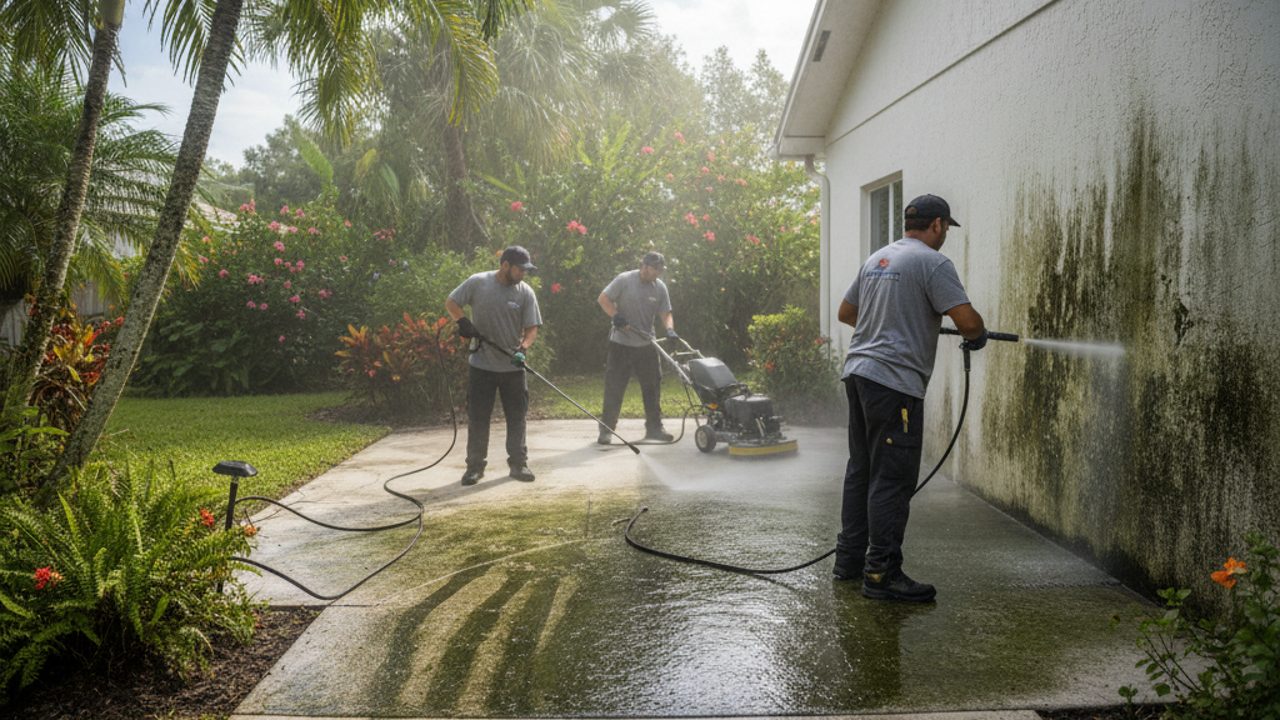
When treating vertical surfaces, the challenge is managing chemical runoff to protect the surrounding Florida-native landscaping. We utilize a 'downstreaming' technique or dedicated 12v pumps to apply a milder 1% to 1.5% SH solution. Pre-wetting all nearby vegetation and performing a post-application rinse is mandatory to prevent foliar burn. The goal is a 'clean kill' of the organic matter, followed by a low-pressure rinse (under 500 PSI) to remove the dead biological film.
Restoring High-Traffic Walkways and Concrete
Concrete walkways and parking garages endure the heaviest microbial load. Unlike roofs, concrete can withstand higher pressures, but pressure alone is insufficient. If you only use a turbo nozzle or a surface cleaner with cold water, you are essentially 'mowing the grass'—leaving the roots of the algae inside the pores of the concrete to regrow within weeks.
Our post-rainy season protocol for concrete includes:
- Pre-treatment: Application of a high-alkaline degreaser and algaecide.
- Surface Cleaning: Utilizing professional-grade surface cleaners with dual-swivel bars to ensure uniform cleaning without 'zebra stripes.'
- Post-treatment: A light application of SH to brighten the concrete and kill remaining subsurface spores.
Comparison of Cleaning Methodologies
| Substrate | Recommended Pressure | Chemical Agent | Primary Objective |
|---|---|---|---|
| Barrel/Clay Tile | < 100 PSI (Soft Wash) | 3-4% Sodium Hypochlorite | Root-level spore eradication |
| Stucco/EIFS | 300 - 500 PSI | 1% SH + Surfactant | Biofilm removal without erosion |
| Poured Concrete | 3000 - 3500 PSI | SH + Degreaser | Deep pore cleaning & brightening |
| Wood Decks/Fences | 800 - 1200 PSI | Sodium Percarbonate | Gentle oxidation & tannin removal |
The Technical Importance of Surfactants
Many DIY attempts at mold cleanup fail because they use household bleach without a surfactant. In the Florida heat, a water-and-bleach mix evaporates too quickly to be effective. Professional surfactants serve three purposes: they reduce surface tension so the algaecide penetrates deeper, they slow the evaporation rate, and they provide a scent mask to mitigate the chemical odor in high-traffic commercial zones. By ensuring a 'wet dwell time' of 10 to 15 minutes, we ensure that the mold is actually killed rather than just bleached white.
Professional Maintenance Schedules
For commercial properties in South Florida, waiting for visible growth often means the damage is already occurring. We recommend a semi-annual maintenance schedule. The post-rainy season cleanup (October/November) is the most critical, followed by a 'freshen up' in May before the humidity peaks. This proactive approach prevents the buildup of slippery biofilms that create slip-and-fall liabilities on walkways and stairs.
Frequently Asked Questions
Why does the mold come back so fast after I pressure wash it myself?
If you use only water, you are leaving the microscopic spores alive within the porous surface. The high moisture levels in Florida allow these spores to regenerate rapidly. A professional chemical treatment is required to achieve a true 'kill' of the organic matter, extending the duration of the clean by 3x to 4x compared to water alone.
Will the chemicals used for mold cleanup kill my tropical plants?
Not when handled by professionals. We use a multi-step mitigation process: pre-soaking the plants to saturate the root systems with fresh water, covering sensitive species if necessary, and continuously rinsing the foliage during the process. This prevents the plants from absorbing the cleaning solution.
Is soft washing actually effective for heavy black mold on a roof?
Yes. Soft washing is the industry standard for roof cleaning. The chemical reaction does the heavy lifting, dissolving the mold and algae. While heavy growth may require a second application, it is far safer and more effective than using high pressure, which can void your roof warranty and cause leaks.
What is the typical cost range for a commercial exterior cleanup?
Commercial pricing varies significantly based on square footage and substrate. Typically, commercial concrete cleaning ranges from $0.10 to $0.25 per square foot, while professional roof soft washing ranges from $0.30 to $0.60 per square foot, depending on the pitch and level of infestation.