King Tide Season: Protecting Coastal Properties From Salt Damage
The Chemical Reality of King Tide Residue
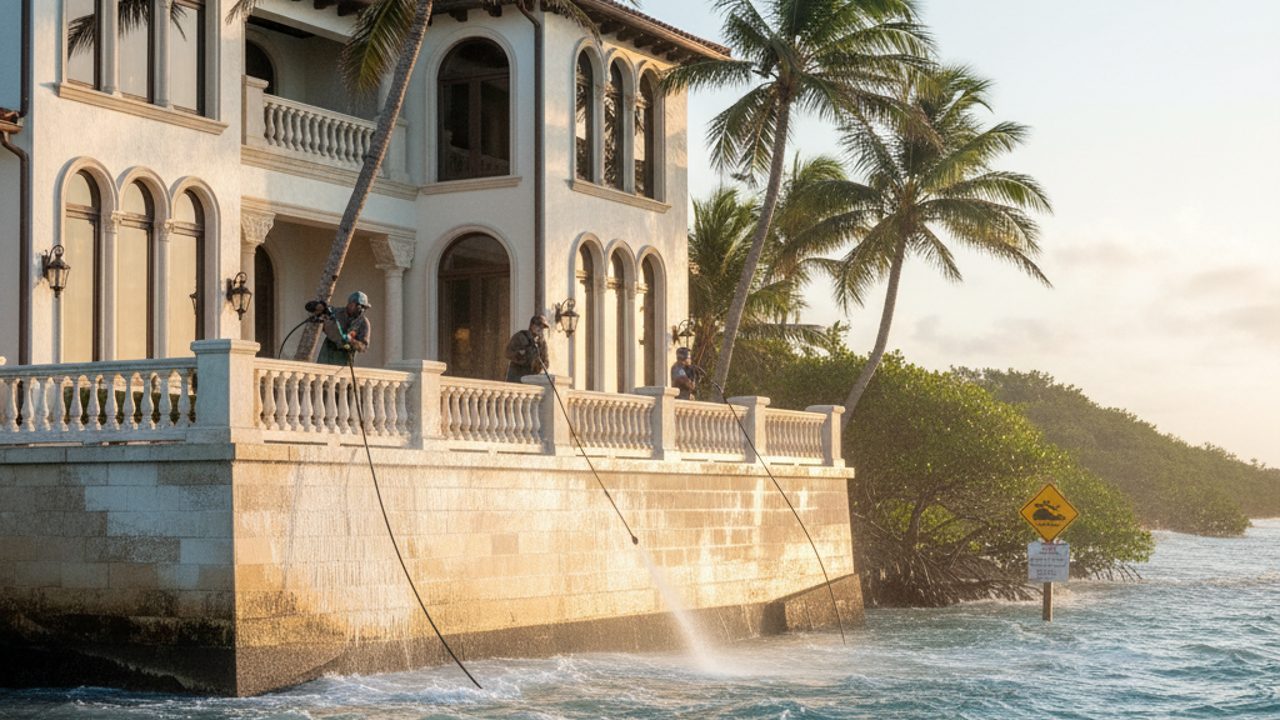
During the fall months in South Florida, particularly around the full and new moons of September through November, coastal properties in Miami Beach and Fort Lauderdale face a significant environmental challenge: King Tides. These exceptional high tides force salt-rich seawater through storm drains and over sea walls, flooding streets and inundating landscapes.
When the water recedes, it leaves behind a highly concentrated saline film. Sodium chloride (NaCl) is hygroscopic, meaning it actively draws moisture from the air. For commercial property managers and homeowners, this creates a persistent cycle of moisture and salt contact that accelerates the oxidation of metal fixtures and the degradation of porous substrates like limestone, concrete, and stucco. Without professional intervention, this residue leads to sub-florescence—where salt crystals grow within the pores of a material, creating internal pressure that causes surface spalling and structural cracking.
Why Standard Pressure Washing Fails During Tide Season
Applying high-pressure water (3,000+ PSI) to salt-laden surfaces is a common maintenance error. High pressure can force salt deeper into the capillaries of concrete or behind the building envelope of EIFS and stucco. At Power Washing And More, we utilize a technical approach categorized as "low-pressure chemical displacement."
We prioritize flow rate (GPM) over pressure (PSI). By using high-volume rinsing, we physically flush the salt ions away from the surface rather than driving them in. Furthermore, we often incorporate salt-neutralizing agents into our wash cycles. These surfactants break the ionic bond between the salt and the substrate, ensuring a cleaner surface than water alone can provide.
Protecting HVAC and Architectural Metals
King Tide season is particularly brutal on mechanical systems. HVAC condensers located near the ground or on low roofs are exposed to salt spray that causes galvanic corrosion on aluminum fins and copper tubing. This reduces heat exchange efficiency and leads to premature system failure.
Our seasonal maintenance protocol for coastal commercial properties includes:
- Low-Pressure Coil Flushing: Removing salt crust from delicate fins without bending the metal.
- Stainless Steel Passivation: Cleaning architectural railings and fixtures with specific chelating agents to restore the protective chromium oxide layer.
- Clear Coating Inspections: Identifying where salt has compromised powder-coated surfaces, leading to "bubbling" or filiform corrosion.
The Role of Sodium Hypochlorite in Coastal Cleaning
While salt is the primary inorganic concern, the increased humidity and standing water from King Tides provide a baseline for rapid biological growth. We utilize professional-grade sodium hypochlorite (SH) solutions, typically ranging from 1% to 3% depending on the surface, to sanitize the area.
This "soft wash" method serves a dual purpose: the SH kills mold and algae spores, while the accompanying surfactants and heavy water rinse lift the salt particles. It is critical to note that for coastal properties, we adjust our mix to ensure the pH balance does not inadvertently react with salt-treated wood or specialized masonry sealers common in high-end South Florida architecture.
Technical Comparison: Salt Impact on Common Substrates
| Substrate | Impact of King Tide Salt | Recommended Mitigation | Service Frequency |
|---|---|---|---|
| Poured Concrete | Scaling and rebar corrosion | Deep rinse + penetrating silane/siloxane sealer | Post-season (Nov/Dec) |
| Stucco/EIFS | Efflorescence and staining | Low-pressure soft wash (< 500 PSI) | Bi-annually |
| Aluminum Rails | Pitting and powder coat failure | Salt-neutralizing surfactant wash | Monthly during Fall |
| Travertine/Stone | Surface erosion and pitting | pH-neutral rinse + hydrophobic sealing | Annually |
Strategic Rinsing Schedules for Property Managers
For commercial assets along A1A or the Intracoastal Waterway, waiting until the end of King Tide season to clean is a financial risk. We recommend a staggered maintenance schedule. In Fort Lauderdale and Miami Beach, the most severe tides often occur in October.
Structural elements like parking garage transition plates, elevator pits, and ground-level storefronts should be rinsed with deionized water or specialized neutralizers immediately following a flood event. This prevents the salt from reaching a "dry state" where it is most corrosive. Power Washing And More provides scheduled recurring services that trigger based on tide cycles, ensuring your asset protection is proactive rather than reactive.
Frequently Asked Questions
Does regular tap water remove King Tide salt effectively?
While tap water is better than no rinse at all, South Florida tap water often contains its own mineral content (hard water). When used on hot surfaces, the water evaporates, leaving both the original salt and new mineral deposits behind. Professional cleaning utilizes surfactants that lower the surface tension of the water, allowing it to penetrate and lift the salt more effectively.
How soon after a King Tide flood should I call for service?
Ideally, surfaces should be addressed within 24 to 48 hours after the water recedes. Once the salt film dries and hardens, it begins the chemical process of ion exchange with the surface, making it significantly harder to remove without higher concentrations of cleaning agents.
Will your cleaning chemicals harm coastal landscaping?
No. We employ a strict pre-wetting and post-rinsing protocol for all surrounding vegetation. By saturating the soil with fresh water before we begin, we ensure the roots cannot absorb the cleaning solution. We also use sodium thiosulfate-based neutralizers where necessary to protect sensitive Florida-native plantings.
Can I just use a high-PSI pressure washer from a big-box store?
We strongly advise against this for coastal properties. High PSI (above 2,500) can etch the surface of salt-weakened concrete or blow out the seals on impact windows. Professional-grade equipment allows us to control the GPM/PSI ratio to ensure we are washing the salt off the building, not into it.