Pool Deck Sealing and Slip Resistance
The Physics of Pool Deck Safety in Florida
In the South Florida climate, pool decks are subjected to constant hydrothermal cycles. Between intense UV exposure and tropical downpours, surfaces like stamped concrete, travertine, and pavers undergo rapid degradation. The primary concern for commercial property managers and homeowners alike is the coefficient of friction (COF). A standard concrete surface, when wet, becomes significantly more hazardous as water fills the micro-pores, creating a hydroplaning effect for foot traffic.
Power Washing And More approaches pool deck sealing not just as an aesthetic enhancement, but as a technical safety intervention. We utilize specialized coatings and anti-slip additives designed to increase the surface profile without compromising the visual appeal of the substrate. The goal is to achieve a balance between protecting the material from salt-air erosion and ensuring a safe walking surface.
Substrate Preparation: The Role of Pressure and Chemistry
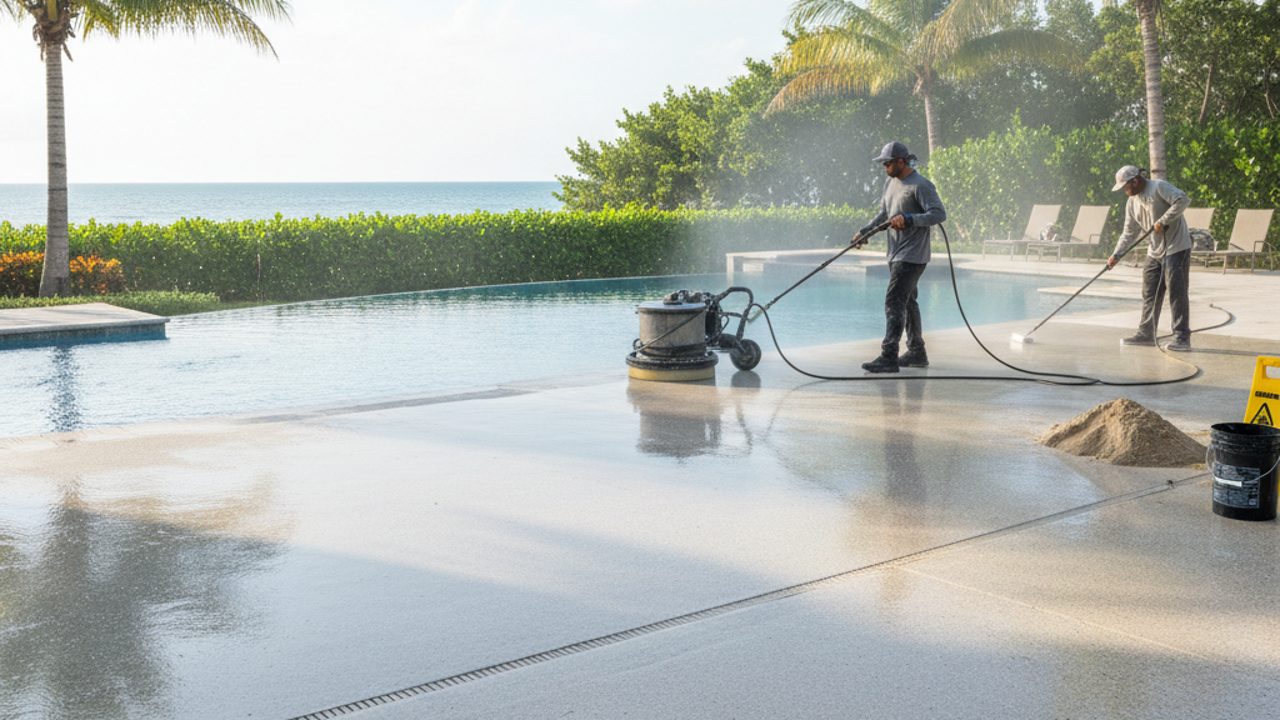
Before any sealant or anti-slip coating is applied, the substrate must be surgically clean. Any organic growth—such as Gloeocapsa magma (black algae) or moss—will act as a bond-breaker, causing the sealer to delaminate within months.
Our process begins with a professional-grade soft wash or high-pressure cleaning depending on the material. For dense pavers or concrete, we utilize surface cleaners at 3,500 to 4,000 PSI to strip away efflorescence and deep-seated grime. For more delicate natural stones like travertine, we lower the pressure and rely on a sodium hypochlorite (SH) solution mixed with specialized surfactants. This chemical application eradicates spores at the root. Once the surface is neutralized and the pH balance is restored, we ensure the moisture content of the substrate is below 12% before proceeding with the sealing phase.
Anti-Slip Additives: SharkGrip and Micronized Polymers
When applying film-forming sealers (like acrylics often used on stamped concrete), the surface can become notoriously slick. To counter this, we integrate micronized polymer granules, such as SharkGrip, directly into the liquid sealer.
Unlike sand, which is heavy and sinks to the bottom of the application bucket, these lightweight polymers remain suspended in the sealer during application. As the sealer cures, these translucent particles create a microscopic texture.
Key technical benefits include:
- Transparency: The additives are nearly invisible, maintaining the color and clarity of the stone or concrete.
- Rounded Edges: Unlike aluminum oxide, which can be abrasive to bare feet, micronized polymers provide grip without being sharp.
- Consistency: Because they stay suspended in the mix, the slip resistance is uniform across the entire deck.
Penetrating vs. Film-Forming Sealers
The choice of sealer significantly impacts both the maintenance cycle and the slip potential of the deck. In Florida, we typically categorize sealers into two types:
- Penetrating Sealers (Silanes/Siloxanes): These move into the pores of the stone or concrete and create a hydrophobic barrier. They do not change the appearance or the texture of the surface, meaning the natural slip resistance of the stone remains unchanged. These are ideal for travertine.
- Film-Forming Sealers (Acrylics/Urethanes): These create a protective layer on top of the surface, offering a "wet look" or high-gloss finish. These require anti-slip additives to be safe for pool-side use.
Comparison of Sealing Options
| Feature | Penetrating Sealer | Film-Forming (Acrylic) | With Anti-Slip Additive |
|---|---|---|---|
| Appearance | Natural/Matte | Glossy/Wet Look | Satin to Glossy |
| Slip Resistance | High (Natural) | Low (Slippery) | High (Textured) |
| UV Protection | Excellent | Good | Good |
| Typical Lifespan | 3-5 Years | 1-3 Years | 1-3 Years |
| Primary Use | Travertine, Natural Stone | Stamped Concrete | Commercial Decks |
Addressing Travertine and Natural Stone
Travertine is the most popular choice for high-end South Florida pool decks due to its ability to stay cool under the sun. However, it is highly porous and prone to staining from tannins (leaves), chlorine, and salt. While many contractors shy away from sealing travertine for fear of making it slippery, Power Washing And More utilizes high-grade penetrating sealers that offer oil and water repellency without forming a surface film.
For commercial applications where liability is a major concern, we can apply specialized topical coatings with high-load anti-slip aggregates. This is particularly effective for high-traffic resort pool areas where the SCOF (Static Coefficient of Friction) must meet specific safety standards.
Maintenance and Long-Term Durability
Sealing is not a one-time event. In the Florida sun, acrylic sealers will eventually break down due to UV radiation. We recommend a maintenance wash every 6 to 12 months using a low-pressure soft wash system to remove surface contaminants without degrading the sealer.
A typical re-sealing schedule for Florida pool decks ranges from every 2 years for acrylics to every 5 years for high-quality penetrating sealers. If the anti-slip texture begins to wear down in high-traffic paths, a maintenance coat can be applied to restore the safety profile of the deck.
Frequently Asked Questions
Does sealing my pool deck make it more slippery?
If you use a film-forming sealer without an additive, yes, it can become dangerously slick when wet. However, by using penetrating sealers or adding micronized polymer grip agents to acrylic sealers, we can actually maintain or improve the traction compared to an unsealed surface.
How long do I have to wait to use my pool after sealing?
Typically, you should wait 24 hours for foot traffic and 48 to 72 hours before moving heavy patio furniture back onto the deck. Humidity levels in South Florida can affect these cure times, so we monitor weather patterns closely during application.
Can you add slip resistance to a deck that is already sealed?
Yes. If the existing sealer is in good condition, we can apply a new topcoat containing anti-slip additives. If the old sealer is failing, whitening, or peeling, it must be chemically stripped before a new, safe coating can be applied.
Will the anti-slip additive hurt my feet?
No. We use micronized polymers that are designed to be comfortable for bare feet. Unlike older methods that used sand or heavy grits, these modern additives provide a subtle, non-abrasive texture that is safe for children and pets.