Is Pressure Washing Safe for Pets and Plants?
Understanding Chemical Ratios in South Florida Exterior Cleaning
When managing commercial properties or residential estates in South Florida, the accumulation of Gloeocapsa magma (black algae) and salt spray is inevitable. To combat these biological contaminants, professional pressure washing companies utilize Sodium Hypochlorite (SH) as the primary oxidizing agent. The safety of your pets and landscape depends entirely on the technician’s understanding of dilution ratios and mitigation protocols.
A typical soft wash solution for roof cleaning may range from 3% to 6% SH, while building siding and pool decks require a much leaner 0.5% to 1.5% mix. At these professional concentrations, the solution is highly effective against organic growth but requires strict adherence to safety standards to ensure the safety of Florida’s sensitive flora, such as Ixora, Hibiscus, and Palm varieties.
The Critical Role of Pre-Wetting and Saturation
The primary defense mechanism for plants during a soft wash or pressure washing service is hydraulic saturation. Plants are most vulnerable to chemical burn when they are thirsty; dry leaves and root systems act like sponges, quickly absorbing any solution that contacts them.
Before any surfactant or oxidizing agent is applied to the structure, our team performs a comprehensive pre-wetting of all adjacent vegetation. By saturating the leaves and the soil to the point of runoff, we create a protective barrier of fresh water. When the cleaning solution eventually makes contact, it is further diluted by the water already present on the plant’s surface, preventing the chemical from entering the plant’s vascular system.
Neutralizing Post-Application Contaminants
After the structural cleaning is complete, the mitigation process enters the neutralization phase. While rinsing with fresh water is the industry standard, high-end landscape protection often involves the use of specialized neutralizing agents. These agents are designed to balance the pH levels of the soil and foliage.
Sodium Hypochlorite is highly alkaline. If left to dry on leaves, it can cause salt burn. By applying a professional-grade neutralizer—often containing a light fertilizer and pH buffers—we ensure that any residual SH is rendered inert. This process is particularly vital for delicate ornamental plants common in South Florida landscaping that do not tolerate high salinity well.
Pet Safety During and After the Wash
For pet owners, the primary concern is the wet state of the treated surfaces. We advise clients to keep pets indoors during the active cleaning process and for at least 1-2 hours following completion. Once the treated surfaces (concrete, siding, or pavers) are completely dry, the Sodium Hypochlorite has broken down into common salt and water, posing no systemic risk to animals.
However, the scent of the surfactants—often citrus or cherry-scented—can be attractive to dogs. We ensure that no standing puddles of concentrated solution remain in low-lying areas of the property. For commercial clients with high pet traffic, such as dog parks or apartment complexes, we utilize additional rinsing cycles to ensure the surface is safe for immediate paw contact once dry.
Safety Protocols Comparison
| Feature | Standard DIY Approach | Power Washing And More Professional Protocol |
|---|---|---|
| Chemical Mix | Unregulated bleach / Water | Metered 0.5% - 3.0% SH with surfactants |
| Plant Protection | None or plastic sheeting | Pre-wetting, continuous rinsing, and neutralizing |
| Pressure | High PSI (3000+) on all surfaces | Soft wash (under 100 PSI) for delicate substrates |
| Soil Health | Potential pH spike | pH-balanced rinsing and soil dilution |
| Pet Safety | Residual chemical puddles | Complete evacuation of runoff and surface drying |
The Importance of Professional Rinsing Techniques
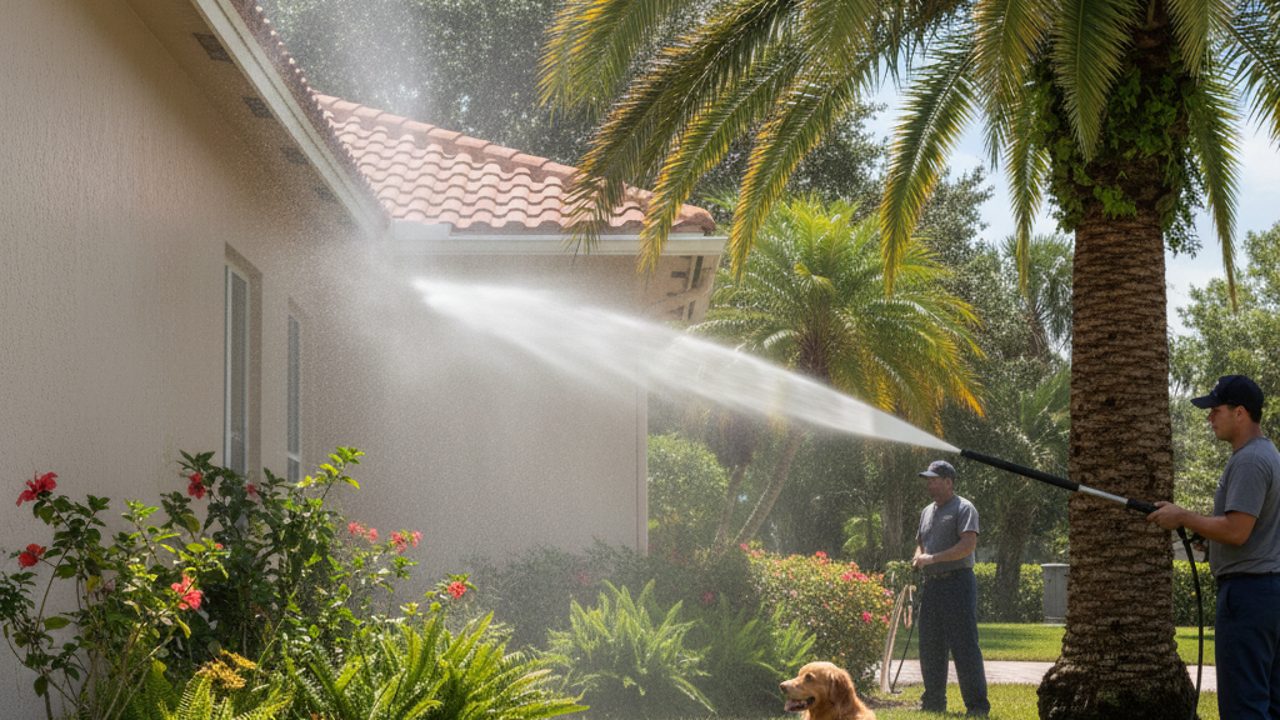
Rinsing is not merely a final step; it is a continuous process. Our technicians practice "perimeter rinsing" throughout the duration of the project. As one technician applies the cleaning solution to the building facade, a second technician is often dedicated solely to rinsing the landscape. This ensures that any overspray is diluted immediately, long before it has the opportunity to dry on the leaf surface. This dual-operator approach is the gold standard for protecting multi-million dollar South Florida landscapes.
FAQ: Landscape and Pet Safety
Will the cleaning solution kill my grass?
When handled by professionals, the risk to turfgrass is minimal. St. Augustine and Bermuda grasses are relatively hardy, but they can suffer from temporary yellowing if a concentrated solution is allowed to sit. By pre-saturating the thatch and soil, and following up with a heavy rinse, we ensure the solution stays on the surface of the contaminants and away from the grass roots.
How long should I wait before letting my dog outside?
We recommend waiting until the treated areas are completely dry. Depending on Florida’s humidity and sun exposure, this typically takes between 60 to 90 minutes. Once dry, the cleaning agents have stabilized and are no longer transferable to paws or fur.
Are the surfactants used biodegradable?
Yes. We utilize professional-grade, biodegradable surfactants specifically engineered for the pressure washing industry. These soaps help the cleaning solution cling to vertical surfaces (reducing runoff) and are broken down naturally by soil microbes without leaving toxic residues in the South Florida water table.
Do you cover plants with plastic during the wash?
We generally avoid covering plants with plastic, as the Florida sun can create a greenhouse effect that cooks the plants underneath in minutes. Instead, we rely on the superior method of continuous hydration and chemical neutralization, which allows the plants to breathe while remaining protected from the cleaning solution.