Holiday Storefront Prep: Cleaning Your Retail Exterior in the Fall
The Q4 Preparation Cycle for South Florida Retailers
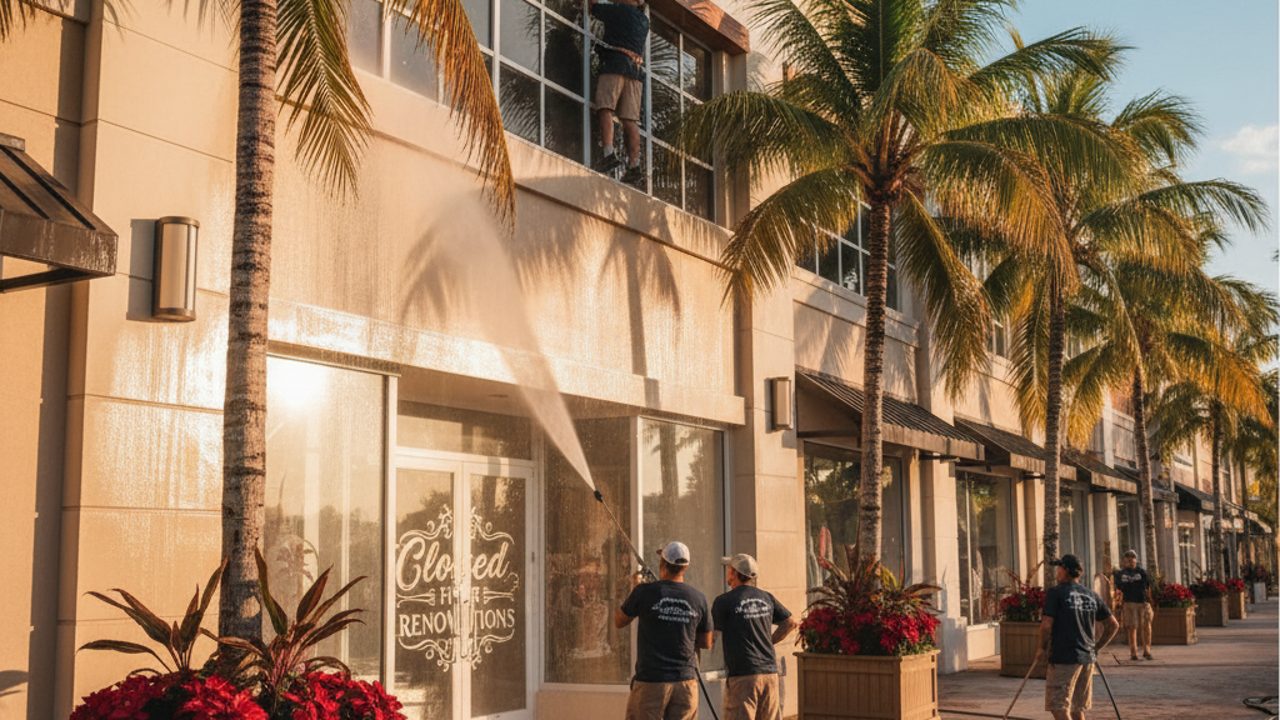
In the South Florida commercial landscape, the transition from fall to the holiday shopping season represents the highest foot traffic period of the fiscal year. From the high-end boutiques on Worth Avenue to the heavy-traffic plazas in Fort Lauderdale, physical appearance directly correlates to customer dwell time and conversion rates. However, the preceding hurricane season and humid summer months leave a specific biological and chemical footprint on retail exteriors.
Accumulated organic growth, salt air deposits, and carbon staining from high-traffic road proximity do not merely dull a building’s aesthetic; they can create slip-and-fall liabilities and degrade structural substrates. Preparing your storefront for the holiday rush requires a technical approach to exterior maintenance that balances high-pressure mechanical cleaning with chemical soft washing to ensure all surfaces are sanitized and preserved.
High-Traffic Sidewalk Restoration and Degreasing
Retail sidewalks are the first physical touchpoint for your customers. During the Florida summer, porous concrete absorbs moisture, leading to the rapid proliferation of Gloeocapsa magma (black algae) and mold. By the time November arrives, these surfaces are often slick and discolored.
For effective holiday prep, we utilize industrial-grade surface cleaners capable of delivering consistent pressure between 3,000 and 4,000 PSI. This mechanical action is supplemented by a pre-treatment of 3% to 6% sodium hypochlorite (SH) solution, which acts as a biocide to kill organic spores at the root.
Special attention must be paid to "hot spots":
- Entryways: Removal of chewing gum using heat-augmented pressure (180°F+) to liquefy the synthetic polymers without scarring the concrete.
- Loading Zones: Application of alkaline-based degreasers to break down hydrocarbons and leaked automotive fluids that have baked into the sun-drenched pavement.
- Curbing: High-PSI edging to remove the buildup of road salt and organic debris that collects in gutters.
Signage Integrity and Facade Soft Washing
Your signage is the most critical element of your brand identity, yet it is often the most fragile. Traditional high-pressure washing can delaminate vinyl lettering, crack acrylic faces, or compromise the electrical seals of LED channel letters.
We employ a "Soft Wash" methodology for all retail signage and building facades. This process involves a low-pressure delivery system (under 100 PSI) that relies on a specialized chemical envelope—surfactants and mildewcides—to break the bond between the surface and the pollutants. This is particularly vital for Dryvit, EIFS, and stucco exteriors common in Florida retail architecture. By eliminating the high-pressure element, we prevent water intrusion into the building envelope while achieving a 100% kill rate on algae and lichen.
Commercial Window and Transom Detailing
Holiday window displays are a significant investment in retail marketing. However, the impact of these displays is negated if viewed through a film of salt spray, mineral deposits, and fingerprints. In South Florida, the combination of high humidity and coastal salt air creates a "crust" on commercial glass that standard squeegee methods often struggle to remove.
Our fall cleaning protocol involves a multi-stage purification process. We utilize water-fed pole systems with four-stage filtration (reverse osmosis and deionization) to ensure the water used has zero parts per million (PPM) of dissolved solids. This results in a spot-free, hydrophilic finish that actually stays cleaner longer because there is no soap residue left behind to attract dust and pollen. For retail storefronts, we also focus on the window frames and mullions, where oxidized aluminum often drips chalky residue onto the glass.
Technical Comparison of Cleaning Methods
| Surface Type | Cleaning Method | Pressure Range | Chemical Agent |
|---|---|---|---|
| Concrete Sidewalks | Surface Cleaning | 3,000 - 4,000 PSI | 4% Sodium Hypochlorite / Degreaser |
| Stucco/EIFS Walls | Soft Wash | 50 - 100 PSI | Surfactant-based Biocide |
| Acrylic Signage | Low-Pressure Rinse | < 80 PSI | Neutral PH Detergent |
| Commercial Glass | Deionized Water | Gravity Fed | Pure H2O (No Chemicals) |
| Metal Awnings | Soft Wash | 100 PSI | Mildewcide Blend |
Awnings and Entryway Overhangs
Fabric and metal awnings are prone to collecting bird droppings and spider webs during the quiet fall months. Because these structures sit directly above your customer's heads, they require meticulous detailing. Fabric awnings (Sunbrella and similar) require a delicate approach to avoid stripping the UV-protective coating. We use a soft-bristle brush agitation combined with a light detergent specifically formulated for marine-grade fabrics. This ensures the colors remain vibrant for your holiday decor transitions.
FAQ: Retail Exterior Maintenance
How often should a South Florida retail storefront be pressure washed?
For high-traffic commercial zones, we recommend a quarterly schedule. The rapid growth of organic matter in Florida’s climate means that a six-month interval often allows algae to become deeply embedded in porous surfaces, making removal more difficult and potentially causing permanent staining.
Will the chemicals used harm my landscaping or holiday planters?
When performed by professionals, no. We use a technique called "pre-wetting" and "post-rinsing" on all surrounding vegetation. By saturating the soil and leaves with fresh water before and after the application of cleaning agents, we ensure the plants do not absorb the surfactants. We also offer non-toxic, biodegradable options for sensitive areas.
Can you perform these services after business hours?
Yes. To minimize disruption to your shoppers and ensure safety, we typically schedule commercial retail cleanings during overnight hours or early morning windows (4:00 AM – 9:00 AM). This allows surfaces to dry and chemicals to dissipate before your first customer arrives.
How do you handle oil stains in parking stalls?
Oil remediation is a chemical process, not just a pressure process. We apply a professional-grade enzyme or alkaline degreaser that eats away at the hydrocarbon chain. While 100% removal of old, deeply set oil stains is not always possible on porous concrete, we can typically achieve a 70-90% improvement in appearance.