Slippery Sidewalks and Liability: Why Algae Removal Matters
The Hidden Liability Beneath Your Feet: Gloeocapsa Magma and Commercial Risk
In South Florida’s humid subtropical climate, a clean sidewalk is more than an aesthetic choice; it is a critical component of risk management. For property managers in Miami-Dade, Broward, and Palm Beach counties, the rapid accumulation of biological growth—specifically Gloeocapsa magma and various cyanobacteria—presents a documented slip-and-fall hazard.
Commercial property owners are legally obligated to maintain a safe environment for invitees. When rain hits a concrete surface colonized by a mature layer of algae, the microorganisms act as a lubricant, significantly reducing the Coefficient of Friction (COF). This creates a surface comparable to ice, leading to potential litigation, increased insurance premiums, and OSHA non-compliance. Understanding the science of algae growth and the technical requirements for its removal is essential for protecting your bottom line.
The Anatomy of a Slip Hazard: Porosity and Moisture
South Florida concrete is typically highly porous. This cellular structure allows water to sit within the substrate, creating a perpetual breeding ground for algae, moss, and lichen. Unlike surface dirt, algae is a living organism that anchors itself into the pores of the concrete.
When these organisms are dry, they are relatively stable. However, during typical Florida afternoon thunderstorms, the algae cells hydrate rapidly. The outer sheath of the algae becomes gelatinous, creating a slick film between a pedestrian’s shoe and the solid surface. If the surface has not been treated with a high-grade sodium hypochlorite (SH) solution to kill the root system, the hazard will return within weeks of a simple water-only pressure wash.
Technical Mitigation: Why High PSI Isn't Enough
Many property owners attempt to mitigate slip risks using high-pressure cold water alone. This is often counterproductive. While 4,000 PSI might strip the surface layer of black algae, it often leaves the spores deep within the concrete’s pores. Furthermore, excessive pressure can lead to "etching," which increases the surface area for future algae to colonize and weakens the structural integrity of the walkway.
Power Washing And More utilizes a dual-action approach:
- Chemical Pre-Treatment: We apply a commercial-grade surfactant and sodium hypochlorite blend (typically 3% to 6% depending on the severity of the growth). This solution breaks the biological bond at a molecular level.
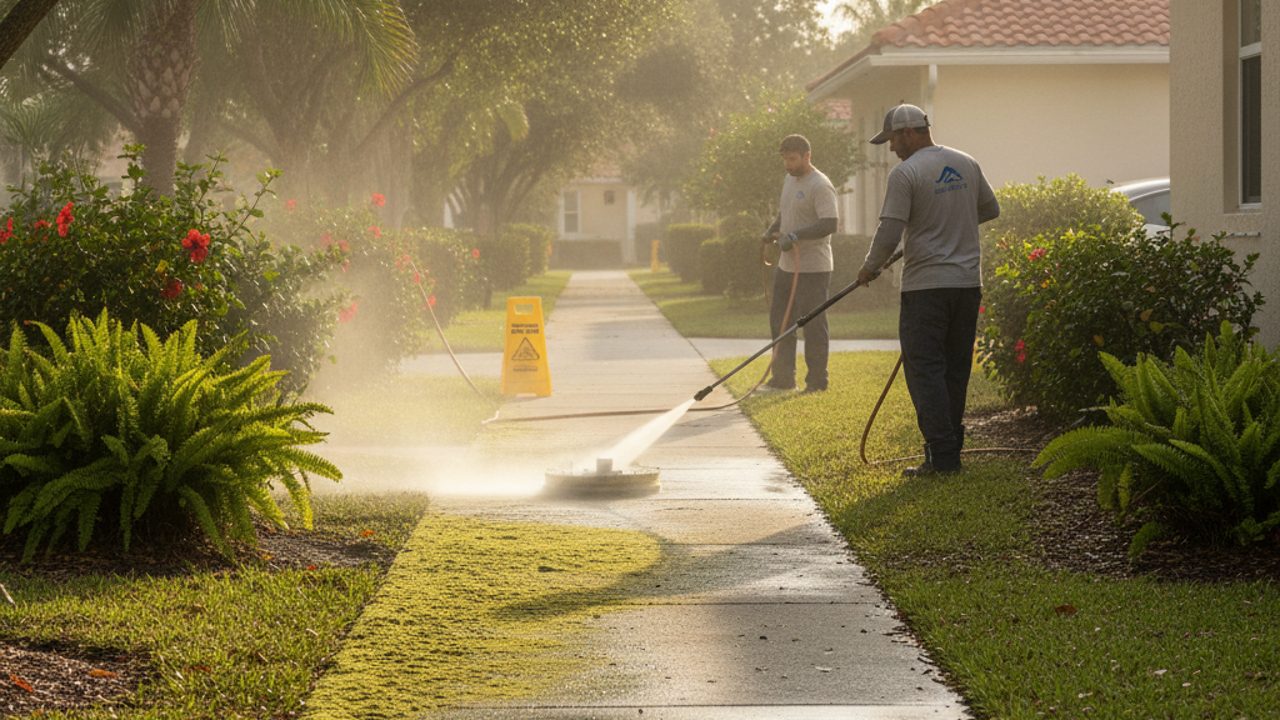
- Controlled Surface Cleaning: Using industrial flat-surface cleaners rather than handheld wands, we maintain a consistent nozzle-to-surface distance. This ensures an even clean at a regulated 2,500–3,000 PSI, which is sufficient for commercial concrete without causing aggregate displacement.
Comparing Surface Conditions and Risk Levels
| Surface Type | Contaminant | Slip Risk (Wet) | Recommended Maintenance |
|---|---|---|---|
| Poured Concrete | Black Algae (Gloeocapsa) | High | Bi-annual SH Treatment |
| Brick Pavers | Green Algae / Moss | Very High | Treatment + Polymeric Sanding |
| Travertine/Stone | Biofilm / Mildew | Critical | Soft Wash only |
| Asphalt | Oil / Algae Mix | Moderate | Low Pressure / Degreaser |
The Economics of Preventative Maintenance
Waiting for a visible "black mat" of algae to appear before scheduling service is a reactive strategy that increases liability exposure. The cost of a professional commercial pressure washing contract is negligible compared to the average settlement for a slip-and-fall injury in Florida, which can range from $15,000 to over $50,000 depending on the severity of the injury and proof of negligence.
By implementing a quarterly or bi-annual maintenance schedule, commercial entities can demonstrate "reasonable care" in a court of law. Professional documentation of these services serves as a defense against claims of premises liability, showing that the owner took active steps to maintain the COF of their walkways.
Environmental and Structural Considerations
Beyond liability, algae removal preserves the asset. The metabolic processes of certain lichens and algae produce organic acids that leach minerals from the concrete, leading to premature scaling and spalling. Our process includes thorough rinsing and neutralization to ensure that runoff does not damage surrounding Florida xeriscaping or enter protected storm drains, adhering to Best Management Practices (BMPs) for wastewater.
FAQ: Commercial Algae Removal
How often should South Florida commercial properties be cleaned to prevent slips?
For high-traffic areas under tree canopies or in shaded corridors, we recommend a minimum of a bi-annual service (every 6 months). Properties with full sun exposure may extend this to 8-12 months, though the North-facing sides of buildings will always accumulate growth faster.
Will the chemicals used for algae removal damage my landscaping?
When performed by professionals, no. We utilize a pre-wetting and post-rinsing technique for all adjacent foliage. We also use specialized neutralizers for sensitive plant life to ensure that the sodium hypochlorite only affects the targeted biological growth on the hardscapes.
What is the difference between pressure washing and soft washing for sidewalks?
Pressure washing uses mechanical force (PSI) to strip surface contaminants, best for dense concrete. Soft washing relies on chemical volume and dwell time to kill the organic growth at the root. For commercial sidewalks, we typically utilize a hybrid approach: a soft wash treatment followed by a low-pressure surface cleaning to remove the dead biological material and restore the surface's natural friction.